Seven questions to ask your graphic designer about your charity impact report
As a designer for more than 20 years, I've designed plenty of impact reports for local and national charities. Creating an effective impact report is about much more than making something look beautiful - it's about communicating a clear, persuasive showcase of your charity's incredible work throughout the year.
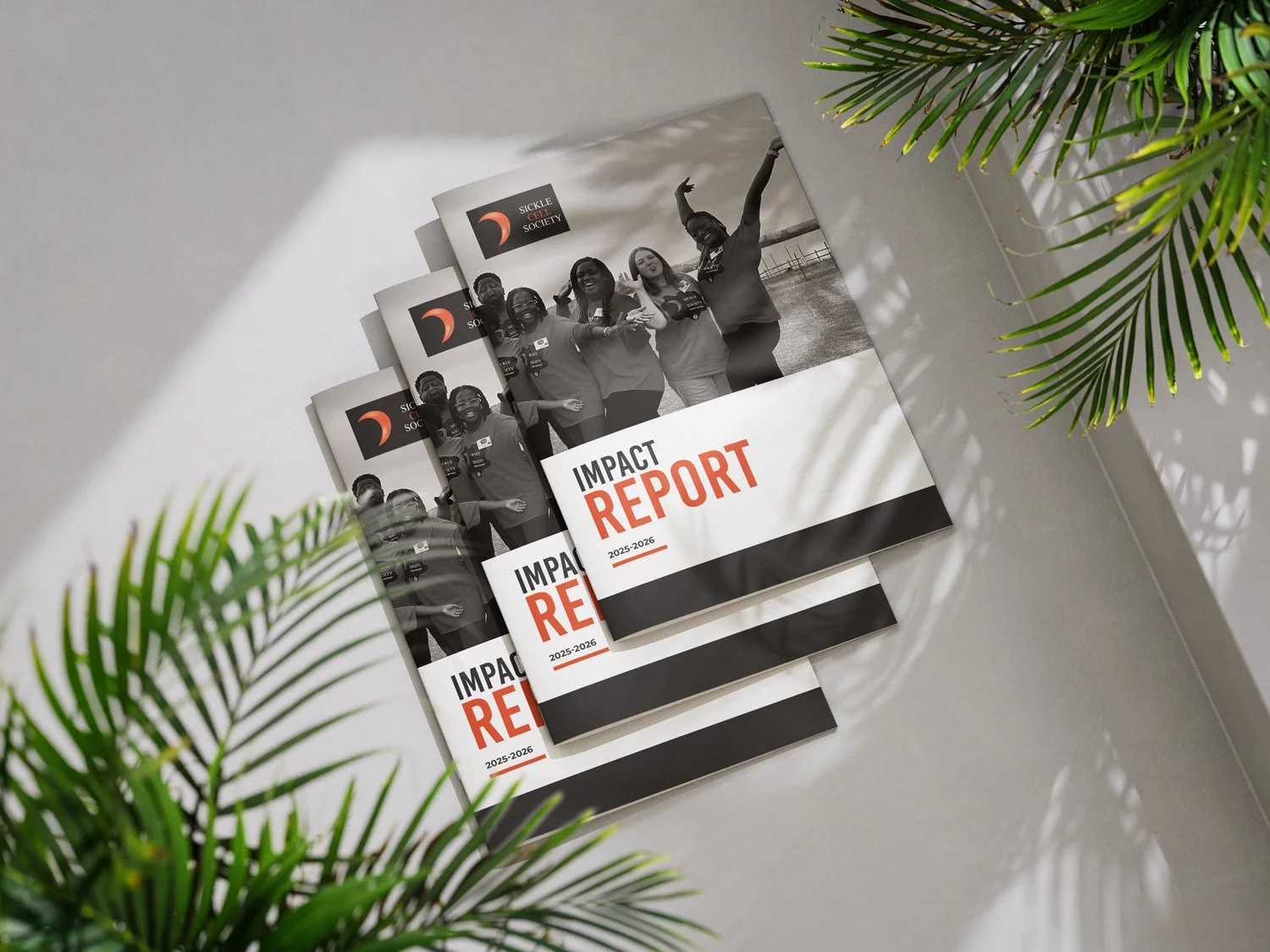
Impact report designed for the Sickle Cell Society.
Your impact report demonstrates your charity's impact across the year in a compelling, accessible way. Let’s face it - you’ll have to work with a graphic designer to bring the impact report to life. Asking someone from your fundraising team or the marketing team to create the report in-house might seem simpler and faster, but it’s a false economy. It’ll take FOREVER for a non-design specialist to get the report looking professional.
A qualified designer has the creative skills to make your impact report not only look absolutely stunning but also shout about everything your charity has achieved.
But how can you be sure the graphic designer will get the result you want?
Once you've got a few designers on your shortlist- you've found a couple on social media and you've also had a couple of referrals. Now's the time to do your research rather than just going with the first person (or the cheapest person) you came across.
Make sure you have a short call with each of the graphic designers on your short list and ask them these seven essential questions. The answers they give will help you make your decision.
1. What experience does the graphic designer have in designing charity impact reports?
Before you speak to the graphic designer, you'll likely have already seen their portfolio through their website and social media. Their work is probably one of the reasons they're on your shortlist in the first place. But it's worth digging deeper into their specific experience with impact reports. Ask the graphic designer to share examples of charity impact reports they've created. Pay extra attention to how they've handled complex data visualisation, storytelling, and the balance between compelling design and clear information hierarchy.
A graphic designer who understands how to present data will save you time and create a more effective charity impact report.
2. Has the graphic designer worked within the charity sector before?
While I don't think sector-specific experience is absolutely essential (good graphic designers are excellent at researching and understanding new industries) it can certainly be beneficial. A designer who's worked with charities before will understand things like:
Charity Commission regulations and compliance requirements
The importance of accessibility in charity communications
How to balance emotional storytelling with factual reporting
Budget constraints that charities may face
Ways to appeal to diverse audiences (from individual donors to major founders)
If the graphic designer hasn't worked with charities specifically, ask how they approach learning about new sectors and what research they'd do to understand your particular area of work.
3. What is the graphic designer’s process for designing a charity impact report?
Understanding a graphic designer's process is crucial for knowing whether you'll work well together. Key things to find out:
Content timeline
When do they need your data and copy? How much flexibility is there if your content is delayed?Concept development
How many initial concepts do they create? Do they provide multiple design directions to choose from?Image sourcing
Are you responsible for sourcing images, or do they handle this? Do they have access to stock photography, or will you need to provide all visuals?Compliance considerations
How do they ensure the design meets charity sector requirements and accessibility standards?
When I’m designing a charity impact report, I have a clear process. After I get the brief from my client, I like to give them two initial concepts to choose from. I usually include a cover and a couple of internal pages for each concept. Once they decide which concept they like best, they send their content over and I put together the entire impact report. I always tell clients that I might end up tweaking layouts to make sure their content looks amazing and works well on the page. From there, we move to the feedback and editing stages—I usually include three rounds of amends.
Every designer works differently, so make sure you're happy with their process.
4. How long will the graphic designer need to create your charity impact report?
You need your charity impact report as soon as possible, but you also need it to look great and communicate exactly why your charity is so brilliant. All of that takes time. On average, I allow four weeks for a complete charity impact report, but make sure you ask your designer about their lead times. Several factors can impact timing:
Collaboration requirements
Do you need multiple stakeholders to sign off? Does your board need to approve content or design?Content readiness
Is your content finalised, or will there be ongoing revisions?Complexity
How data-heavy is your report? Are there complex infographics needed?
Deadlines exist for good reasons, and it's essential to make sure your designer can finish your project on time. Otherwise, that has a negative knock-on effect for the rest of your marketing plans or launch plans. If a designer can't meet your deadline, but it isn't set in stone, you could work together to find something that works for both of you.
Good designers get booked up in advance and rarely have time to fit in last-minute projects. Start having conversations with the people you want to work with as early as possible.
5. Who owns the artwork of your charity impact report?
This is absolutely crucial to establish upfront. You want to make sure that the charity owns the original artwork once your impact report has been designed. If the charity does not own the art work you can be restricted in how you can use the art work beyond the impact report itself. You might not have permission to repurpose the visual elements for presentations, social media, or future campaigns.
In the UK, when you commission a designer to create a report, any infographics, or any visual communications, the designer automatically own the copyright unless specified otherwise in your contract.
My contract clarifies who owns what at the end of the project. When it comes to your impact report design, you own every visual element outright as soon as you've paid the final invoice. You can adapt sections for grant applications, repurpose infographics for your website, or use design elements across your communications without restrictions.
I make this clear to every charity and organisation I work with because your impact story should belong entirely to you.
Note: I'm not a copyright expert or lawyer, so please don't take this as legal advice! If you have questions about design ownership and usage rights, consult with a legal professional.
6. What are the exact deliverables the graphic designer will produce?
The designer is going to use lots of different software to create your charity impact report. Depending on where you plan on using the report, you’ll need to report in different formats or files.
For example, if you’re planning for the charity impact report to be printed and posted to every donor, you’ll need one type of file. If you’re only going to share the report online or digital, you’ll need the same report but in a different file.
Each designer will have a different approach, so you might receive different deliverables from one designer to the next.
Typical deliverables might include:
Print-ready PDF
This is a high-resolution file suitable for professional printingDigital PDF
This is a file which has been optimised for web sharing and email distributionIndividual infographics
These are separate files for social media and website useEditable source files (e.g., InDesign)
Not all designers provide these, so if having them is important to you make sure you let them know.Various formats
These could be JPEGs for web use or PNG files with transparent backgrounds which are often used on social media or websites to promote your charity’s impact report.
I make sure my clients know exactly which files and which format they'll receive when we finish a project, before they decide whether they want to work with me or not.
It's really important to nail down the scope of the deliverables at the very beginning, so if you want infographics supplied as separate files, make sure your designer is aware of that.
7. How do they prefer to receive feedback, and what happens if you don’t like the initial concepts?
This is really important because sometimes a designer might get it wrong—and that’s nobody’s fault. You need to find out:
What happens if you don’t like any of the initial concepts
How many rounds of amends are included in the project quote
Their preferred method for receiving feedback (email, calls, collaborative platforms)
How they handle major revisions versus minor tweaks
Make sure these processes are outlined in the quote or at least given to you in writing. Every designer handles this differently. When it’s happened on my projects, I make sure to talk each design through with the client to find out exactly what they don’t like and where things might have been misunderstood. We then find a way forward that works for both me and my client.
For me, it’s really important to share all of this with my clients before they sign on the dotted line. And when it comes to edits on the actual report, I like to share files via Adobe or Google Drive where my clients can mark up comments on the files directly.
I also ask my clients to collate feedback so that the editing stage is as streamlined as it can be.
Getting your charity impact report right
Getting your charity impact report right is crucial; it's often the first impression donors, funders, and stakeholders get of your year's hard work. Beyond the numbers, it’s a vital platform to share the real-world impact that your team makes every day for the people they support. It’s about honouring the dedication of your staff and the resilience of your community by telling their stories with dignity and clarity.
By asking these seven key questions upfront, you'll find a graphic designer who not only creates something beautiful but truly understands your mission and works in a way that suits your charity's needs. Remember, the cheapest option isn't always the best value, and the most expensive doesn't guarantee quality. Take time to find someone whose process, experience, and approach align with your goals.
Your impact deserves to be showcased properly, and the right designer will help you tell that story in a way that inspires and engages your audience.
Lets talk about your impact
If you’re starting to think about your next report and want to ensure it truly captures the heart of your work, I’d love to help. With over 20 years of experience designing reports, I can help you navigate the process - from data visualisation to storytelling - without the stress.
Get in touch today for an informal chat about your project and to see how we can work together to bring your charity’s story to life.